Saturday, February 26, 2022

How Canterbury Tales' Prologue Reveals the Narrator's Social Status


Image source: Wikimedia Commons

Paper Format: APA

Subject: English Literature/ Canterbury Tales

Question:

B‌‌‌‍‍‌‍‌‌‍‍‍‌‍‍‍‌‍‍elow is an excerpt from the “General Prologue” of the TheCanterbury Tales (In your textbook, the passage begins on page 313, line 725). The speaker is the narrator. Basing your answer on textual evidence, in which estate (class) would you place the narrator? What qualities does the narrator share wi‌‌‌‍‍‌‍‌‌‍‍‍‌‍‍‍‌‍‍th one other pilgrim? You may refer to and quote passages from the text outside of the one provided below. Develop an argumentative point in your answer. Quote and explain textual evidence in your answer. (30 points) The responses to each of the short essay questions must be approximately 300 words ‌‌‌‍‍‌‍‌‌‍‍‍‌‍‍‍‌‍‍long.

 725 But first I pray yow, of youre curteisye,
726 That ye n' arette it nat my vileynye,
727 Thogh that I pleynly speke in this mateere,
728 To telle yow hir wordes and hir cheere,
729 Ne thogh I speke hir wordes proprely.
730 For this ye knowen al so wel as I:
731 Whoso shal telle a tale after a man,
732 He moot reherce as ny as evere he kan
733 Everich a word, if it be in his charge,
734 Al speke he never so rudeliche and large,
735 Or ellis he moot telle his tale untrewe,
736 Or feyne thyng, or fynde wordes newe.
737 He may nat spare, althogh he were his brother;
738 He moot as wel seye o word as another.
739 Crist spak hymself ful brode in hooly writ,
740 And wel ye woot no vileynye is it.
741 Eek Plato seith, whoso kan hym rede,
742 The wordes moote be cosyn to the dede.
743 Also I prey yow to foryeve it me,
744 Al have I nat set folk in hir degree
745 Heere in this tale, as that they sholde stonde.
746 My wit is short, ye may wel understonde.

Answer: 

Social Class in Canterbury Tales 

            The type of people a character often interacts with can provide hints about their social status. Other indicators of social status in a person include their education status, spending behavior, and their thoughts and value systems. In the prologue to Canterbury Tales, the narrator exhibits noble-background characteristics in his value system, education status, and spending behavior.

Firstly, Chaucer and his audience share similar expectations about modesty with upper-class families, indicating that he has connections with the royalty. Society expects people with royal-family connections to behave modestly; Chaucer, fearing that he might mention things that his audience might perceive as displays of "crudeness," requests them not to blame him for these words (Chaucer, 1948, 46). Moreover, the narrator is happy about Prioresse's table manners: "She leet no morsel from hir lippes falle" (Chaucer, 1948, 9). Therefore, the narrator and his audience share values that typical members of a royal family would hold.

Secondly, Chaucer's education status hints to his upper-class background. During the 14th and 15th centuries period, education was very expensive hence only accessible to the rich. The narrator seems well educated; first, he is conversant with "Holy Writ" (Chaucer, 1948,47). Second, he can connect his discussions with other people's writings. For instance, has said, he quotes Plato: "Who-so that can him rede / The words mote be cosin to the dede" (Chaucer, 1948, 47). Moreover, considering the period's information scarcity, Chaucer seems highly aware of recent and historical events, a privilege that only the upper class enjoyed due to their close contacts with the palace. Therefore, the narrator's vast knowledge indicates his affluent, royal background.

Lastly, being able to afford pilgrimage indicates that the narrator has much money. The working class, peasants, and the unemployed would rarely engage in pilgrimage due to its monetary and time costs. Furthermore, the hotel where the narrator spends the first night seems expensive, considering that the people who go there for accommodation are mostly rich. The narrator also says he received only the best treatment at the inn (Chaucer, 1948, 3), further emphasizing his moneyed status. Therefore, Chaucer's spending behavior suggests that he is from a noble family.

In conclusion, the narrator has a noble-family background because his ideas about modesty match with those of people who come from upper-class families. The narrator's education status is also apparent in his knowledge about history and books, further revealing his rich background. Chaucer's expensive lifestyle is also an indicator of his affluence.

Reference

Chaucer, G. (1948). Canterbury Tales: An International Translation. Vincent H.F. (ed.). Barron's Education Series. 1-47. 


Sunday, February 20, 2022

UNFORGIVEN BY CRAIG SHERBORNE: Marriage, Infidelity, and Conventionalism


Image source: Wikimedia commons

Paper Type: Book Review
Paper Format: APA
Pages: 4

Question:

 Choose one work from the four listed below and write an analytical essay that discusses the ethics of representation in relation to the work. Points to consider may include the following questions: Is the theme of the work a delicate or taboo topic in our culture? Why? What is the relationship between the writer and the key subject(s) or theme and how can this be said to have influenced the work? What research methods have been used by the writer to produce the text and to what extent are these methods visible, reliable or objective? How does the writer’s use of techniques of representation – for instance tone, point of view, imagery, dialogue, structure – shape the work’s ethical implications?

 How have assumptions about genre impacted the reception of the text by readers? What sort of ethical issues (if any) arose for you in your reading of the work? Your essay will be marked on the quality of the analysis and argument presented, the strength of the writing and the professionalism of the presentation. 

APA 6th edition referencing style is a requirement for this assignment.

  1.  Fiction Garner, Helen. Excerpt from The Spare Room. Melbourne: Text Publishing, 2008. 1-18. Print.
  2. Memoir/Personal Essay Kinsella, John. “Fellow Travellers.” Fast, Loose Beginnings: a Memoir of Intoxication. Carlton, Vic.: Melbourne. University Press, 2006. 58-85. Print. Sherbourne, Craig.
  3. “Unforgiven.” The Monthly. February 2008. 36-43. Print. 

Answer

Infidelity, Marriage, and Conventionalism in Unforgiven

By bearing, raising, and imparting norms to children, families ensure the continuity of societies. It is, therefore, not surprising that cultures place many rules to enhance the stability of families. Traditions have rules to protect these social institutions and provide readymade solutions whenever they experience impasses. In the West, these conventions not only encourage adult men and women to marry and retain their marriage for as long as possible but also discourage infidelity and divorce, which may destabilize families (Brundage 2009). Western culture also prefers that people keep matters regarding sex private, and those who talk openly about sex acts or organs appear deviant. However, the extent to which these conventions are valid or beneficial is unclear. In Unforgiven, Craig Sherborne explores uncomfortable topics that directly or indirectly challenge the dominant perceptions about male-female relationships and question the validity of the traditional family (Sherborne, 2008). The author represents marriage as an institution that should only exist when couples love one another and end when the love diminishes, portrays true love as a temporary concept, and views modern conventions about female objectification and eroticism as mere inconveniences.

First, the story seems to convey that marriages, just like love, should not necessarily be permanent but should end when a couple loses love. The first meeting between Alex and the narrator is a reflection of what one would call true love. Indeed, Alex does not have any material interest in the narrator, who lives in a “room so small it’s called the box” and does a low-paying job (Sherborne, 2008). Alex herself is expecting a large sum of money from her divorce settlement and does not need to be economically dependent on the narrator. That Alex nevertheless courts the narrator is evidence of her genuine love. Similarly, the narrator’s genuine interest in Alex is evident in the fact that he does not demand anything from the woman upon their divorce. Up to the time when Alex goes for mastectomy, the narrator is satisfied with the relationship. Here, the author shows that marriages that disintegrate are not necessarily those built upon lies or material interests of couples; that even marriages that begin with true love sometimes fail. Eventually, in some marriages, the so-called genuine feelings between couples wither, and partners get “very, very bored” (Sherborne, 2008). This stance is revolutionary, especially in Western societies, where people perceive the truth as a static, verifiable, and one-dimensional concept “that transcends history and culture” (Maffie, 2001). Sherborne’s narrator perceives true romantic feelings as unstable; that people can transfer these feelings from one individual to another without compromising their morals. Therefore, unlike the dominant representations of true love and marriage as long-lasting and static, the author presents these concepts as temporary and manipulatable.

Second, the author also portrays marital infidelity as an expression of honesty and a potential means to individuals’ happiness. After Alex’s operation, it is evident that the narrator loses interest in the marriage. From the story’s perspective, continuing to stay together is not the best option for the two people who dislike one another. The narrator cites Alex’s nagging as the cause of his disinterest in the marriage, but this is not true. Indeed, it is interesting that the narrator suddenly finds Alex’s expressions of insecurities and the task of continually assuring her that he loves her to be daunting. After this operation, the narrator does not even want to touch his wife: “I begin to dread the touch of her” (Sherborne, 2008). However, Alex has always been insecure since they met, yet the narrator does not complain during the initial stages of the relationship. For instance, during their stay in London, Alex often expressed disgust for her breasts and doubts about the narrator’s love for her. That said, the narrator is not necessarily immoral or cruel for holding these views about love. Indeed, he struggles to revive his waning interest in Alex unsuccessfully; he frequently kisses his wife and indulges her in sex despite having lost interest in these acts. Moreover, he frequently assures Alex that he loves her, and even during arguments, when his wife orders him to leave or throws away his belongings, he always decides against walking away. Through this innocent portrayal of both characters, Sherborne draws the reader’s empathy toward both characters. While portraying Alex’s innocence and justifying her anger, the author also presents the narrator’s predicament with the same empathy, suggesting that some marriages sometimes simply end because there is no benefit in their continuity. Like Alex and the narrator, married couples who refuse to end unfulfilling unions only subject themselves to infidelity and pain. Therefore, infidelity itself is not a problem but an honest indicator of a marriage that is already dysfunctional and that should have ended long ago.

Sherborne also ventures into sensitive topics regarding eroticism, female objectification, and conventionalism. The descriptions of sexual intercourse in the story are quite graphic. The author delves into erotic details of sex organs and activities that some people might find uncomfortable to read, especially in public. Secondly, the narration raises questions and doubts regarding the concept of true love. That the narrator’s attitude towards his wife changes just after the mastectomy indicates that, for a woman to attract the narrator’s true love, she must have two intact breasts and a generally desirable body. In other words, removing breasts from a woman eliminates the narrator’s interest in her, and that is why his love shifts to Janet, who possesses bodily features that Alex lacks; “That curve of hip; that bust, a complete bust without unevenness or sagging. The earth’s deepest browns for her eyes” (Sherborne, 2008). It also seems that the author rejects the concept of the social contract and demonstrates why it is unfair, especially to men. Notably, women get divorce settlements from their rich husbands upon divorce, yet the question of compensation does not arise when men break away from their rich wives. The narrator only carries his clothes when leaving Alex. On the other hand, Alex receives much money from her first husband. Also, marriages only meet women’s desire for children and do not have any meaningful benefit to men, yet society expects males to be faithful and monogamous. Alex’s anger issues partly arise because her susceptibility to cancer does not allow her to have children. Therefore, these divergent perceptions about marriage, women’s bodies, and sex indicate the author’s skepticism about conventionalism.

In conclusion, Unforgiven raises pertinent questions about society’s view of male and female relations, sex, and marriage. Notably, it challenges the notion that couples should remain married even when they are no longer intimate, labeling non-intimate marriages as worse than infidelity. Staying in a loveless marriage only causes more unhappiness and is not worthwhile.  Also, just because the love between two people ends at some point does not discredit mean that their earlier feeling toward one another was not real. Alex and the narrator share genuine love at first, but this romance wanes eventually. The couple’s attempt to remain together, which eventually proves futile, only leads to more hatred and suffering for both. Moreover, while the author points children and wealth as the benefit that women acquire from marriage, it is not apparent how these unions benefit men.


Monday, February 14, 2022

Discussing Gender and Identity in William Shakespeare's Writings: MACBETH, AS YOU LIKE IT, TITUS ANDRONICUS


                                                image source: Wikicommons


Question: 

Discuss how gender and identity are explored in TWO Shakespearean writings. (MACBETH, AS YOU LIKE IT, TITUS ANDRONICUS.)

Part 4. The Final Paper

The Final Paper will have the following parts:

1.    An introduction where you provide relevant background for your presentation. This may be on Shakespeare, his plays, the theme you are considering, or any relevant historical information. The introduction should indicate why this topic is important for your chosen audience. At the end of the introduction, you will state a thesis that makes an assertion about the plays and their common theme.

2.      An examination of the way your chosen theme operates in each of the three texts. Consider such issues as race, gender, justice, and/or other themes from our class readings and discussions.

3.      Well-organized body paragraphs containing a close reading of specific examples from the plays, including brief quotations. (Do not quote extensive passages.)

4.      A conclusion that sums up the value of your research and analysis and shows how understanding Shakespeare is important for your particular audience.

5.      A works cited page (using MLA 8th edition documentation style)

Documentation Style: The paper is to be formatted and documented in the Modern Language Association (MLA) 8th edition style. For assistance with MLA style, see the UMGC library MLA guide with MLA Citation Examples: http://sites.umgc.edu/library/libhow/mla_examples.cfm

Deliverable for Part 4: The paper will consist of parts 1-5 above. Please format the transcript in MLA style. The paper should be carefully edited and proofread for standard use of English.


Purpose: The purpose of the project is to allow you an opportunity to explore and develop a presentation to demonstrate why Shakespeare’s plays are relevant in the contemporary world. In this project, you will address the importance of Shakespeare’s literary contributions to contemporary culture by creating a presentation that addresses the following situation:

Imagine that you are addressing a group about the importance and relevance of Shakespeare to our own time. Your job is to convince the group of Shakespeare’s ongoing importance by providing a close reading of three plays, with special focus on one theme they all share. MACBETH, AS YOU LIKE IT, TITUS ANDRONICUS You must choose two of these plays from our syllabus; the third does not have to be. Your job is to examine each play in detail, providing a close reading and interpretation that demonstrates (1) the theme and (2) the importance of the theme to your specific contemporary audience.

Audience: Choose the audience for your presentation from among the following. (You may suggest another group, but it must be approved by the instructor.)

·         A college English department that is considering creating a new themed Shakespeare course

You must use a minimum of five scholarly sources. At least four sources must be from the UMUC databases. Please see the sources below

Length: The paper will be from six to eight pages double-spaced in Times Roman 12 (1,500 to 2,000 words).

Theme: Gender and Identity

You will examine the way this theme operates in each of the three plays you will consider, using specific scenes and incidents to support your view of how the theme operates in each work. Your overarching goal in discussing the theme in these plays is to demonstrate the importance of Shakespeare’s work to your audience. For example, if you are addressing a school board, you will use the plays and their shared theme to show how important Shakespeare's work is for students’ learning. If you are addressing the potential theater donors, you will use the plays and their theme to show why Shakespeare is relevant to contemporary audiences.


Answer


Shakespeare's Female Characters as Models for University Courses

One prime task of university education is to open people's minds and increase their problem-solving abilities. Indeed, most of the problems that humans face today exist due to closed mindsets. For instance, significant environmental damages occur because humans emphasize making profits and ignore conservation. Similarly, radical religion, a facilitator of terrorism, war, and death, is merely a human creation. Another critical area of this blindness manifests in the gender imbalance, which itself threatens social stability. Shakespeare's books provide a means to analyze older societies, real and fictitious, through their characters and create a stage for cultural comparisons between these societies and our own. Shakespearean plays explore the intricate relationship between women and the broader society. In analyzing the female characters of Shakespeare's plays Macbeth, As You Like It, and Titus Andronicus, students will be exposed to concepts of gender that do not conform to traditional societal norms.

Shakespeare Exposes Women's Mistreatment

These plays help institutions to expand the discourse about female mistreatment and identify the baselessness of these norms. It has become normal to treat females as second class humans across the world. For instance,  the number of women holding political posts across the world is conspicuously low. It is time that students critically assessed the sources of these attitudes that normalize discriminating women (Kimbrough 175). Shakespeare's plays provide an excellent foundation for beginning such a discussion because, just like in modern societies, women in these plays are victims of baseless traditional notions.

In As You like It, society disregards women for no other reason but that they are women. For example, Duke Frederik, while expelling Rosalind away from his court, claims that he is doing so because Rosalind is too "smooth" (Shakespeare, "As You Like It," I.iii.20). This instance implies that considering someone as "too feminine" is enough reason to deny them comfort. Moreover, Touchstone reveals how society applies a reductionist approach to women's personalities. According to the character, having knowledge of poetry and being pretentious are the only metrics for determining the perfect woman. Moreover, Touchstone views women as lairs by default, and for him, to have an honest woman is like "to have honey a sauce to sugar" (Shakespeare, "As You Like It," III.iii.62).

In Titus Andronicus, Tamora experiences an injustice from Titus when the latter kills her eldest son. Being a woman, she cannot do anything but cry. Moreover, the casualness with which Chiron and Demetrius plan to rape Lavinia or "to pluck a dainty doe to ground" (Shakespeare, "Titus Andronicus," II.ii.96), and the ease with which they execute their plan before cutting off the victim's tongue and hands, mirror both the literal and figurative aspects of day-to-day situations that women experience across the world. In the literal aspect, cases of women undergoing rape and gruesome murders are common in news outlets. Figuratively, society silences rape victims through victim shaming, thereby essentially cutting out victims' tongues. Moreover, just like Lavinia's assailants taunt her, many rapists do not face punishment or imprisonment and continue to threaten and taunt their victims. 

As evident in the plays and modern examples, societies mistreat women, and it is time universities spearheaded discussions through Shakespearean plays to expose this mistreatment. Shakespeare demonstrates how people use customs with no logical bases to oppress and despise women; there are no logical foundations for such customs. Only by acknowledging this baselessness of can more students support women's rights and champion equality.

Women as Influencers of Humanism and Reason

Shakespeare provides a platform to demonstrate the influential role that women play in the world and demonstrate their indelibility in society.  The perception of women as unnecessary and an inconvenience is prevalent today (Mehdi & Khoshkham 2), and there is a need to reemphasize the role of women in society; one only has to look at the small number of women getting respectable employments occupying top-level posts in governments and corporates as compared to men. Also, in parts of the world, women have no female-friendly facilities in institutions, and accessing basic things like sanitary pads and birth-control services is difficult in some countries.  This female sidelining is not coincidental; it occurs because people think women are useless; hence, they do not deserve positions, services, items, or laws that specifically address their needs (Sorge 323). Shakespearean plays provide a useful reference point from which universities can explore and challenge these negative notions. Shakespeare provides a platform for female characters from which people can analyze women's role in society. By no means does Shakespeare attempt to over-romanticize the female character (Kimbrough 175). Instead, the author places the female character in the play's familiar environment, and other than giving some women prominence based on their positions as lead characters, neither does he undervalue the female character nor portray her as a superhuman. Therefore, in a way, Shakespeare's plays provide a "natural environment" for understanding women.

In As You Like It, women like Rosalind, Celia, and Audrey provide examples from which students can draw lessons about objectivity, romance, self-esteem, and integrity.  In the society that Shakespeare creates in this play, people tend to gravitate towards the extreme, and women serve as adjustments that return people to reason. For instance, when Jacques, who claims that' tis good to be sad and say nothing" (Shakespeare, "As You Like It," IV.i.73), adopts overly reductionist thinking that makes him see nothing good about life and immerses him in perpetual sadness, Rosalind reminds him that one is not better than a "post" if they can do nothing but be sad (Shakespeare, "As You Like It," Iv.i.73).  Rosalind shows the same objectivity when she tries to prove to Orlando, herself, and other people that predeterminism does not apply to romance. In other words, the character hypothesizes that the universe does not, by default, assign love to particular pairs of people and that someone can develop or lose romantic attraction to another person at any time. The play also uses female characters to explore the meaning of true friendship: Celia, whose connection with Rosalind is "dearer than the natural bond of sisters" (Shakespeare, "As You Like It," I.ii.26), embodies true friendship when she abandons her comfortable court life to follow her cousin, whom Duke Frederick has expelled from his household.

The lessons that these characters espouse in the examples above are crucial to university students, especially regarding managing their expectations, finding value in living, and being sensitive. Notably, romance-related suicides and homicides are common among university students (Karbeyaz et al. 111). People have hung themselves or murdered their lovers just because they have been "heartbroken." Perhaps by studying Rosalind's hypothesis about love, people can become more realistic in understanding that love sometimes ends. Also, through Celia and Rosalind's relationship, students can learn and extend the debate about true friendship. For instance, during lessons on conflict theories, one can create a lively class debate by telling students to dissect Rosalind and Celia's relationship and find the common interest that sustains this friendship. Therefore, female characters in Shakespearean plays expose a vast cache of potential topics of debate, theories, and lessons and provide new standpoints from which people can analyze, criticize, or support popular theories.

Demonstrating the Dangers of Oppressing the Female

Men and women need to work together to contribute to the world's progress. However, the female's opinion has been sidelined in almost all critical sectors. In STEM professions, for instance, women are conspicuously few, and this means that many research and development facilities lack significant female contributions that could produce more advanced, affordable, and effective processes, services, and goods. For instance, studies hint that females better photographic memory than men (Wang 991), which means that investigative and research facilities might be missing a lot by failing to employ women. However, apart from the loss that the world is experiencing by underutilizing women, another danger in the form of women's destructive power presents itself when society continues to oppress the female, and Shakespeare explores this danger in characters like Lady Macbeth in Macbeth and Tamora in Titus Andronicus. Seeing no benefit in a social structure that does not recognize them, these two women decide to facilitate anarchy.

In Macbeth, the Victorian society dictates that women remain unrecognized and that if they need to succeed, they have to do so through their husbands' progress. This situation leaves Lady Macbeth with no other option but to pursue her success through her husband's success (Mehdi & Khoshkham 2). Lady Macbeth dispises the powerlessness, poverty, and mediocre life that society assigns to people based on their social class and gender, as evident in this excerpt:

To be the same in thine own art and valour,

As thou art in desire? Wouldst thou have that

Which thou esteem' st the ornament of life,

And live like a coward in thine own esteem

Letting "I dare not" wait upon "I would,"

Like the poor eat I' th' adage (Shakespeare, 'Macbeth," I.II.26)

Consequently, Lady Macbeth adopts an unorthodox means to extricate herself from this oppression and achieve her power and wealth goals: she convinces her husband to destroy the establishment by killing the king. However, rather than getting the comfort she wanted, Lady Macbeth exposes herself and other people to more instability and suffering, especially when the dead king's ghost starts to haunt her family. Therefore, by sidelining Lady Macbeth, society triggers the woman's appetite for power and destruction (Zohreh 57).

Titus Andronicus's Tamora also starts a deadly mission after society denies her rights as a woman. By forcefully bringing Tamora to a foreign land and killing Tamora's son, Titus leaves the woman hopeless. From then onwards, Tamora has no other interests but to cause further destruction to the already "headless Rome" (Shakespeare, "Titus of Andronicus," I.i.79).  This example indicates how a culture of hatred emerges when society disregards and oppresses women.

Conclusion

If the world is to have any hopes for stability, universities need to acknowledge that society's discrimination of women is a threat to world balance and underutilization of the feminine power. Thus, universities must create courses that specifically target to expose this imbalance and cure people's ignorance. Shakespearean plays provide great examples from fictitious and real societies that can drive the discourse on gender. Female characters in Titus Andronicus, As You Like It, and Macbeth demonstrate women's power; in these plays, women are sources of reason, integrity, and humanism. However, women could also destroy the world if they continue to feel oppressed. Therefore, these plays provide rich material for universities on gender studies.


Works Cited

Karbeyaz, Kenan, Mehmet Toygar, and Adnan Çelikel. "Completed suicide among University Students in Eskisehir, Turkey." Journal of forensic and legal medicine 44 (2016): 111-115.

Kimbrough, Robert. "Macbeth: The Prisoner of Gender." Shakespeare Studies (0582-9399), vol. 16, Jan. 1983, p. 175. EBSCOhost, search.ebscohost.com/login.aspx?direct=true&db=asn&AN=7166190&site=eds-live&scope=site.

Mehdi Amiri, and Sara Khoshkam. "Gender Identity and Gender Performativity in Shakespeare's Selected Plays: Macbeth, Hamlet and Merry Wives of Windsor." Advances in Language and Literary Studies, vol. 8, no. 4, Aug. 2017, pp. 1–7. EBSCOhost, doi:10.7575/aiac.alls.v.8n.4p.1.

Shakespeare, William. As you Like it, edited by Wilbur Cross, Tucker Brooke, and Willard Durhan. 1919.

Shakespeare, William. Macbeth, edited by Richard Grant. Houghton, Mifflin & Company. 1897.

Shakespeare, William. Titus Andronicus, edited by John Wilson. Cambridge University Press. 1948.

Sorge, Kelly. Masking Femininity: Women and Power in Shakespeare's Macbeth, As You Like It, and Titus Andronicus. 2017, https://scholars.unh.edu/cgi/viewcontent.cgi?article=1327&context=honors. 

Wang, Bo. "Gender difference in recognition memory for neutral and emotional faces." Memory 21.8 (2013): 991-1003.

Zohreh Ramin. "Shakespeare's Richard III and Macbeth: A Foucauldian Reading." K@ta: A Biannual Publication on the Study of Language and Literature, vol. 15, no. 2, Jan. 2013, pp. 57–66. EBSCOhost, search.ebscohost.com/login.aspx?direct=true&db=edsdoj&AN=edsdoj.4c7085710f442318f956f3c73e2178d&site=edslive&scope=site.


Monday, March 8, 2021

Shakespeare’s Twelfth Night and Quintilian’s Insight on Humor

 Shakespeare’s Twelfth Night and Quintilian’s Insight on Humor


Understanding Humor: Quintilian and Shakespeare's Twelfth Night (Draft/not editted yet)

Humor is complex to produce because many factors determine whether people will consider a concept humorous. Often, it is difficult to explain why people construe an event or individuals to be funny in one social context and yet find the same event or individual boring or repulsive under a different context. Nevertheless, Quintilian, who asserts that humor arises from “nature and opportunity,” contributes partially to its understanding. Events in Shakespeare’s Twelfth Night validates Quintilian’s implication that individuals possess unique characteristics that make them humorous, that humor relates to social class, and that the wittiest people craft their humor from reactions.

Specific individuals have a unique set of decipherable and indecipherable characteristics that makes them appear funny to particular audiences more than other people. In what Quintilian refers to as the salsus of an individual, the author argues that people possess comedic appeals “in their looks or manners” that vary from one person to another (358). While most of this charm is innate, individuals can make limited effort to increase or decrease their salsus. In Twelfth Night, Feste exhibits both innate and artificial traits that make some people consider him funny. Artificially,  Feste’s clown costume contributes to his funny appearance. Festes tells Olivia, “Lady, ‘Cucullus non facit monachum’—that’s as much to say as I wear not motley in my brain” (I.v.31), indicating that he regularly wears a clown costume and that the cloths influence his character. However, Feste also has inherent, indecipherable characteristics that make him comedic. For instance, despite his insolent attitude and the fact that he contributes no labor in his master’s household, Olivia enjoys having him around. She even terms Feste’s insults as “birdbolts” that cause no damage (I.v.35). Also, in the attempt to be funny, Malvolio clads a clown costume and exaggerates his character, but his techniques fail as he lacks inherent comedic charm. Instead of laughing at Malvolio when he starts behaving absurdly, people perceive him as insane and lock him away. It is ironical that Malvolio and Feste’s act similarly, at least in their dressing, yet people take Feste to be normally functioning while treating Mavolio as insane. Therefore, a combination of both outward, manipulatable characteristics and inherent characteristics, which are unique to a particular social setting, is necessary to appear funny.  

There also seems to be a form of hierarchical dominance in funniness, in which people who identify with lower social hierarchies tend to be funnier than those who occupy higher hierarchies. In this case, people acquire their place in the social hierarchy by combining three components: modesty, physical appearance, and wealth. Modesty refers to the ability to conform to behaviors that society regards as respectable. In the Elizabethan society, people who practice monogamy, wear decent dressing, and drink little alcohol are considered more modest (Roducanu 22); hence, other factors constant, a person will occupy a higher social class than those who overdrink or act promiscuously. Also, the more wealth one possesses, and the more desirable their physical appearance, the higher their social class. However, as a person climbs the social hierarchy, the number of individuals who consider them to be funny reduces (Quintilian 359). A good example is Orsino’s and Olivia’s rather serious characterizations as compared to the funny characterizations of Sir Toby and Sir Andrew. Even though both pairs come from the same economic class, going by their titles, the latter pair arguably attract slightly lower respect due to their heavy-drinking habits. Similarly, to lower their "social value," clowns have to exaggerate their physical appearance by adorning adorn clown costumes and behaving absurdly. In other words, people who look normal or desirable physically, economically, and behaviorally are less likely to cause laughter. Therefore, the less social status one occupies, the more likely the person to appear funny.

Perhaps this propensity of the disadvantaged people to be funny is because such individuals often possess more non-desirable characteristics that expose them to derision. "Laughter is never far removed from derision," says Quintilian, who further asserts that people often use the deformities in others to create comedy (Quintilian 359). Individuals with higher social statuses tend to be admirable hence have fewer follies that other individuals may criticize for comedic effect than those of low social standing. This concept also implies that an environment increases its capacity for comedy as it amasses people with socially undesirable characters. For instance, a hall full of drunken people (assuming that society derides drunkenness) will be arguably more comedic than a hall full of teetotalers. A similar trend in the relationship between comedy and social status is noticeable in the play: Sir Toby, knowing Sir Andrew's foolishness, influences the latter to behave foolishly for his enjoyment. For instance, he praises Sir Andrew’s dancing skills and convinces him to dance (I.III.21). Moreover, Sir Toby seems to derive joy in seeing Sir Andrew's desperate gestures to Olivia, and that is why he deceives his friend to continue with the romantic pursuits. Also, by saying that his niece cannot marry "above her degree, neither in estate, years, nor wit” (I.iii.21), Sir Toby indirectly insults his friend, who does not notice.  Therefore, people who are socially deviant and who occupy low social statuses are more likely to serve as sources of laughter than those of higher statuses. 

Lastly, Quintilian implies that wit is often more effective if it is reactionary, which is evident in Twelfth Night. “Wit always appears to greater advantage in reply than attack” (Quintilian 359). Indeed, many characters in Shakespeare derive their funny comments from responses to other people's statements. For instance, when Maria criticizes Sir Toby’s drinking habits, the latter quips that he will drink "as long as there is a passage in my throat" (I.III.15).  Similarly, when Olivia orders her servants to eject Feste from her household, telling them to “Take away the fool,” Feste challenges her, stating that Olivia's dead brother has gone to hell. Olivia insists that her brother is in heaven. Feste then pronounces, “The more fool, madona, to mourn your brother’s soul, being in heaven. Take away the fool, gentlemen!” (I.V.33). Moreover, when Malvolio says that he will report Maria to her mistress for misbehaving, Maria humorously compares Malvolio to a donkey, telling him, "Go shake your ears" (II.III.68).  Therefore,  many instances of wit arise from responses, as evident in the play.

In conclusion, Quintilian identifies various aspects of humor, thereby contributing to its partial understanding. Notably, specific individuals are naturally humorous based on their charm and tendencies to behave or dress in a particular way. Also, people who possess a higher proportion of socially undesirable characteristics are likely to be funnier than those who align with norms. Lastly, an individual's ability to craft wit as responses increase their tendencies to be regarded as funny. Shakespeare's Twelfth Night contains examples of individuals and circumstances that Justify these claims.


Works Cited

Raducanu, Adriana. "The Ghost Tradition: Helen Of Troy In The Elizabethan Era." Gender Studies 13.1 (2014): 22-36.

Shakespeare, William. “Twelfth Night,” edited by John Andrews. Doubleday Books and Music Clubs. (1994).


Tuesday, May 19, 2020

Complexities of Human Condition in Shakespeare's Hamlet


The Complex Human Condition as Portrayed in Hamlet


Many thoughts, actions, and experiences fuse and influence each other, creating various sets of characteristics in a person that make it impossible to understand the individual. Boudry et al. (2015) say that adaptive rationality, that is, the thinking processes directing people's immediate actions, do not always align with personal rationality—the individual's perception of right and wrong. This concept applies to characters in Hamlet (Shakespeare, trans. 2012). Shakespeare employs the themes of societal expectations, mortality, and situational irony, alongside the characterizations of selfishness and craftiness to explore human complexities in Hamlet. 

Firstly, societal expectations cause behavioral changes in the protagonist that manifest in either conformity or rebellion. Hamlet seems to have developed the belief that everyone is innocent until proven guilty (Shakespeare, 2012, 3.2.144 – 145). Consequently, the protagonist delays punishing Claudius until he ascertains the king's crimes. The concept of justice, according to Kendall and Nouwen (2012), is subjectively created and defined by society; the protagonist is merely conforming to societal rules. In another instance, however, Hamlet rebels against laws forbidding monarchs from sharing affection with people from other social classes when he says that, if Ophelia had forty thousand brothers, his love for her would surpass theirs combined (Shakespeare, 2012, 4.7.185 – 186). Therefore, by imposing expectations on Hamlet, society has caused him to react by either conforming to or rebelling against it. 

Secondly, mortality as a theme reveals complexities in the life of the protagonist, who worries about death. According to the ghost, Hamlet's father, who died before atonement, suffers in hell every day. Hamlet wants to kill the man who murdered his father, but he fears the villain will skip hell if he dies while praying, thereby failing to get punished (Shakespeare, 2012, 3.3.146 – 147). Moreover, Hamlet wonders why men value their miserable lives but fear death, which they know nothing about. Having developed contempt for life, Hamlet becomes more courageous; he resolves to conclude his mission (Shakespeare, 2012, 3.1.128 – 129). Concerns about mortality, therefore, shape Hamlet's character and situation.

Shakespeare also uses situational irony to portray human complexities. For instance, it is contradictory that Hamlet seems to respect and love his mother, yet she adores his father's murderer. Similarly, the people Hamlet trusts with his secrets—Bernardo and Marcellus—are the same who guard the kingdom that he detests (Shakespeare, 2012, 1.5.101 – 102). It is also ironic that Hamlet constantly thinks about killing the king, but whenever he finds the opportunity, he decides against it. These and other contradictory instances in the play make it difficult to understand the protagonist.

Also, the author explores self-centeredness in Hamlet that reveals imperfections, thereby complicating the character's condition. For example, it is selfish of Hamlet to speak rudely to Ophelia when he knows that the girl's father decides everything for her. It is also selfish that Hamlet leads innocent actors to recite lines that inflict guilt upon Claudius (Shakespeare, 2012, 3.2.138 – 139). Using powerless people to anger a king is selfish as he might decide to punish the actors. Hamlet's selfishness, therefore, displays his complex personality, which is neither wholly good nor entirely evil.

Lastly, Shakespeare presents Hamlet as a crafty character, thereby making him difficult to predict. When he tells Claudius that he is too much in the sun, for instance, it is easy to interpret the statement literally, yet he may be using the sun to refer to his father (Shakespeare, 2012, 1.2.63 – 64). Furthermore, Hamlet successfully leads everyone—except his loyal friends—into believing that he is insane. Due to these tricks, the protagonist completes the vital mission of proving Claudius's guilt. Therefore, by making Hamlet unpredictable, Shakespeare presents the complexity of the human condition.

In conclusion, Hamlet's situation reflects the multifaceted nature of human life. Using the themes of societal expectations, situational irony, and mortality, Shakespeare explores these intricacies. He further does this by characterizing the protagonist as selfish and crafty. These methods combine to create situations and reactions that propel the play.

References

Boudry, M., Vlerick, M., & McKay, R. (2015). Can Evolution get us off the Hook? Evaluating the Ecological Defence of Human Rationality. Consciousness and Cognition33, 524-535.

Kendall, S., & Nouwen, S. (2013). Representational practices at the International Criminal Court: The Gap between Juridified and Abstract Victimhood. Law & Contemp. Probs.76, 235.

Shakespeare, W. (2012). The Tragedy of Hamlet: Prince of Denmark. J. Tobin (Ed.). Boston, Massachusetts: Wadsworth/Cengage Learning. 1 – 199.


Late on your paper? Whatsapp +254726557037 for ideas.

Guaranteed 24-hour turnaround time.


Monday, May 18, 2020

ACADEMIC BOOK REVIEW: THE STRANGE CAREER OF JIM CROW, VANN C. WOODWARD

BOOK REVIEW: THE STRANGE CAREER OF JIM CROW, VANN C. WOODWARD

Image source: Wikimedia commons


Paper Type: Book Review
Paper Format: MLA
Pages: 6 pages


Wednesday, April 8, 2020

SUBJECT: PSYCHOLOGY. How Caffeine Impairs Cognitive Function


Sample Academic Paper
Subject: Psychology
Paper Format: APA
Question: Does caffeine enhance or impair cognitive function?

Need help with your class work? Whatsapp +254726557037


Need help with your class work? Whatsapp +254726557037


Need help with your class work? Whatsapp +254726557037

Content:  

How Caffeine Impairs Cognitive Function
Philip Fulu
Institutional Affiliation


How Caffeine Impairs Cognitive Function
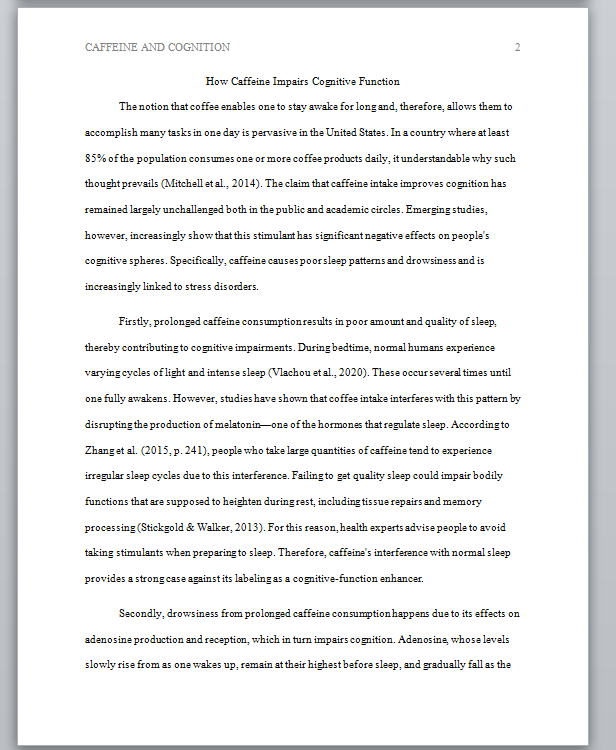
The notion that coffee enables one to stay awake for long and, therefore, allows them to accomplish many tasks in one day is pervasive in the United States. In a country where at least 85% of the population consumes one or more coffee products daily, it understandable why such thought prevails (Mitchell et al., 2014). The claim that caffeine intake improves cognition has remained largely unchallenged both in the public and academic circles. Emerging studies, however, increasingly show that this stimulant has significant negative effects on people's cognitive spheres. Specifically, caffeine causes poor sleep patterns and drowsiness and is increasingly linked to stress disorders. 
Firstly, prolonged caffeine consumption results in poor amount and quality of sleep, thereby contributing to cognitive impairments. During bedtime, normal humans experience varying cycles of light and intense sleep (Vlachou et al., 2020). These occur several times until one fully awakens. However, studies have shown that coffee intake interferes with this pattern by disrupting the production of melatonin—one of the hormones that regulate sleep. According to Zhang et al. (2015, p. 241), people who take large quantities of caffeine tend to experience irregular sleep cycles due to this interference. Failing to get quality sleep could impair bodily functions that are supposed to heighten during rest, including tissue repairs and memory processing (Stickgold & Walker, 2013). For this reason, health experts advise people to avoid taking stimulants when preparing to sleep. Therefore, caffeine's interference with normal sleep provides a strong case against its labeling as a cognitive-function enhancer.
Secondly, drowsiness from prolonged caffeine consumption happens due to its effects on adenosine production and reception, which in turn impairs cognition. Adenosine, whose levels slowly rise from as one wakes up, remain at their highest before sleep, and gradually fall as the person sleeps, signals the brain to rest (Singh et al., 2020, p. 118). While caffeine discourages sleep by reducing the brain's sensitivity to adenosine, it does not prevent the accumulation of the hormone, which increases the longer one stays awake (Cui et al., 2020, p. 149). To remain awake, the individual, therefore, has to consume caffeinated products after short intervals to counteract the rising adenosine. Moreover, the brain, having interpreted less adenosine sensitivity to mean shortage, signals for more production to compensate for the perceived deficiency (Abumoh et al., 2020, p. 39). This creates a situation in which the body frequently switches from states of alertness to drowsiness. Moreover, the brain’s sensitivity to coffee’s stimulation reduces with long-term consumption. On the contrary, the sensors remain receptive to the high levels of adenosine. This makes one constantly tired and sleepy (Abumoh et al., 2020, pp. 39 – 51). Under conditions of exhaustion, it is difficult to concentrate, hence cognition is impaired. 
Another reason for concern about caffeine intake is the growing body of evidence that links it to stress disorders. Although inconclusive, a recent study suggests that consuming coffee-based energy drinks could lead to heightened stress in young men (Sawah et al., 2015).  In an earlier study, the researchers divided groups of rats that had undergone stressful experiences into two and then administered caffeine to one division. Unlike their counterparts, rats that received doses of caffeine had signs of stress, including loss of appetite, fear, and poor maze navigation (Pattenuzo et al., 2008). Furthermore, without a previous history of stress, another group of rats, which also received caffeine doses, presented these discomforts, thereby suggesting that caffeine has the potential to induce anxiety. Therefore, although the relationship between coffee intake and stress disorders requires further examination, these findings should suffice to discourage one from consuming coffee.
In conclusion, is difficult to agree with the claim that caffeine enhances cognition when available evidence indicates otherwise. Not only does coffee cause sleep disturbance, but it also causes drowsiness in consumers. Besides, caffeine has been linked to increased stress levels in animals; and there are signs that caffeine could cause stress issues in humans. Until research in this area is conclusive, people should minimize or avoid consuming caffeinated products.

References
AbuMoh, M. F., & Al-Junaidi, I. (2020). Effects of Caffeine Ergogenicity on Short Intense Aerobic Exercise, Prolactin, and Dopamine in Sub-Elite Long-Distance Runners. International Journal of Coaching Science14(1), 39-51.
Cui, W. Q., Wang, S. T., Pan, D., Chang, B., & Sang, L. X. (2020). Caffeine and its main Targets of Colorectal Cancer. World Journal of Gastrointestinal Oncology12(2), 149.
Mitchell, D. C., Knight, C. A., Hockenberry, J., Teplansky, R., & Hartman, T. J. (2014). Beverage Caffeine Intakes in the US. Food and Chemical Toxicology63, 136-142.
Sawah, M. A., Ruffin, N., Rimawi, M., Concerto, C., Aguglia, E., Chusid, E., ... & Battaglia, F. (2015). Perceived Stress and Coffee and Energy Drink Consumption Predict Poor Sleep Quality in Podiatric Medical Students: A Cross-Sectional Study. Journal of the American Podiatric Medical Association105(5), 429-434.
Singh, B. L., Chen, L., Cai, H., Shi, H., Wang, Y., Yu, C., ... & Cai, X. (2019). Activation of Adenosine A2a Receptor Accelerates and A2a Receptor Antagonist Reduces Intermittent Hypoxia-Induced PC12 Cell Injury via PKC-KATP Pathway. Brain Research Bulletin150, 118-126.
Stickgold, R., & Walker, M. P. (2013). Sleep-Dependent Memory Triage: Evolving Generalization Through Selective Processing. Nature Neuroscience16(2), 139.
Vlachou, M., Siamidi, A., Pippa, N., & Fikioris, N. (2020). Fast Sleep Onset Pharmaceutical Formulation of the Chronobiotic Hormone Melatonin. Advanced Science, Engineering and Medicine12(3), 439-442.
Zhang, L. F., Zhou, Z. W., Wang, Z. H., Du, Y. H., He, Z. X., Cao, C., & Zhou, S. F. (2015). Coffee and Caffeine Potentiate the Antiamyloidogenic Activity of Melatonin via Inhibition of Aβ Oligomerization and Modulation of the Tau-Mediated Pathway in N2a/APP Cells. Drug Design, Development, and Therapy9, 241.
Need help with your class work? Whatsapp +254726557037